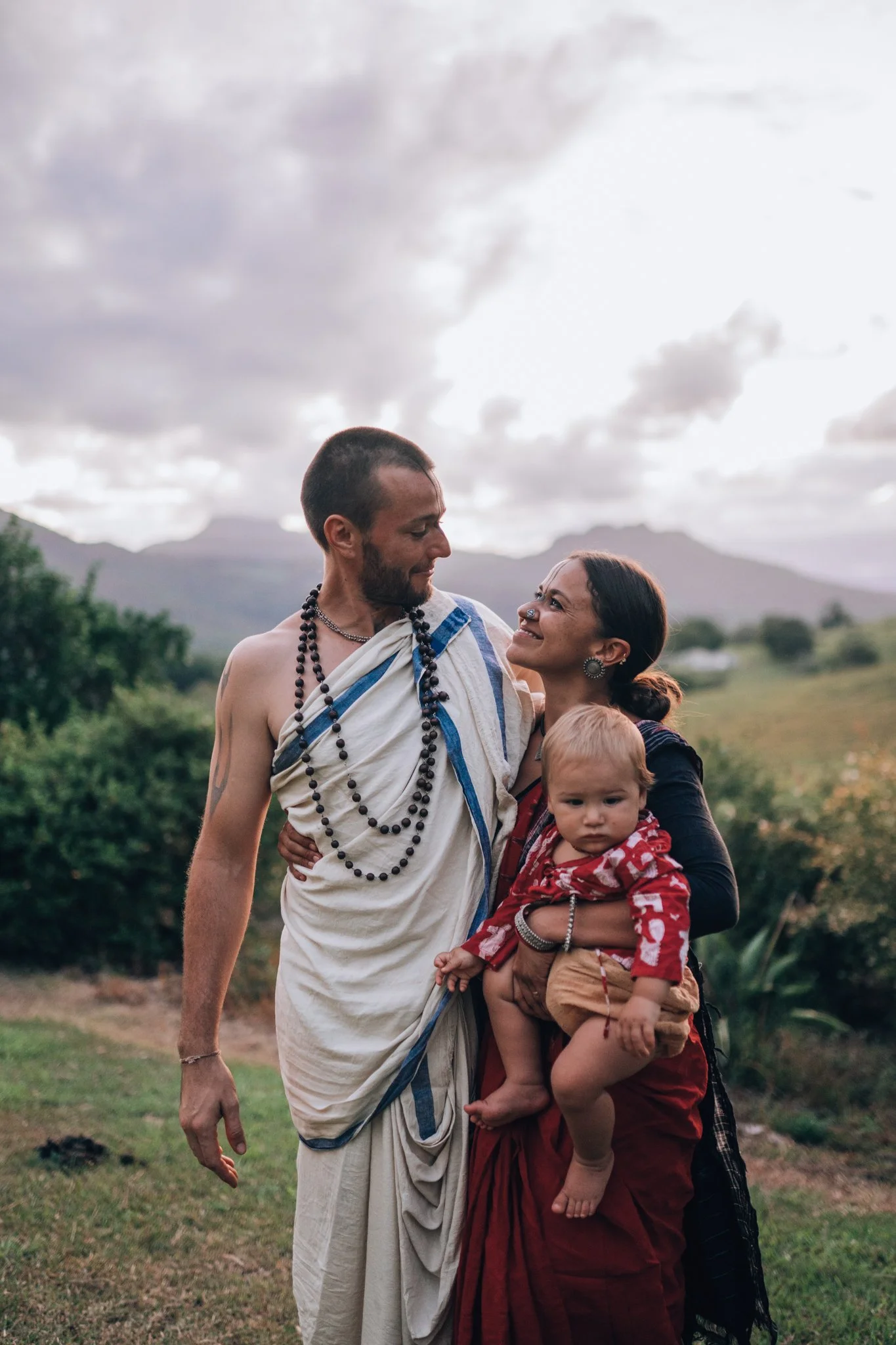
Our Family
Abhimanyu and Yasomati have been learning and practicing Bhakti Yoga and the mysticism of Sanatana Dharma, under the guidance of Sri Gurudeva, for the past thirty years.
They are passionate about preserving and sharing this ancient wisdom which can transform your home, relationships and body, into a temple of God.
We hope to provide techniques, philosophy and education on vaishnava arcana, homa, kirtan, mantra, japa and meditation orientated towards family life.
Welcome to Tiny Temple!

Tiny Temple is a small family sanctuary for bhakti arts and culture. We share dance, writing, kirtan, ritual, and conversation as living sadhana — a way to explore the body, the heart, and the mystery of God together.
We are Yasomati and Abhimanyu, with our children Aniruddha and Gambhira. Yasomati holds Nayikas, a dance school rooted in lineage and devotion: dance as a lifetime practice through which people in community can systematically meet the physical and metaphysical aspects of being. Abhimanyu writes Ananta’s Journal and hosts Tremors from the Heart, a podcast on Bhakti yoga and Vaishnava Tantra with friends. Together we try to offer a life-positive, aesthetic, non-sectarian path — chanting, singing, meditation, ritual, and ordinary family life.
How we arrived here: Abhimanyu was born in Los Angeles on 5 August 1988 and named after the valiant nephew of Krishna from the Mahabharata. His parents had come into the Hare Krishna movement in the 1970s from Catholic backgrounds — his father Irish, his mother Portuguese. From the first years of life the world was temples, farms, kirtan, and travel. Earliest memories are of playing in and around those places: wonder, mystery, and a childhood that was never ordinary.
The family moved often. After a short time in Hawaii they spent years in and around New Talavan in Mississippi, then North Carolina, stretches of sankirtan on the road across much of America, a year of public school in Detroit while his father was treated for lymphoma, and later the return to farm life. At eleven he was already working concert lots — stickers, hats, a line about a soup kitchen — learning how to read a crowd and survive a itinerant devotee household. Schooling was patchy: homeschool, gurukula pods, one memorable year of football and friends in Harper Woods. His younger brother Gauravani was born there.
At twelve the family moved to Mayapur. The teens were spent in that intense world of tirthas, Ganga baths, daily ritual, soccer, jiu-jitsu, and the books. He read the printed volumes and then the sources they pointed to, learned the yearly cycle of festivals, kept a morning puja for two decades, and tried to understand the philosophy well enough that it could not be used only as a tool of control. He also came to see the shadows that many second-generation devotees carry: poorly resourced schools, isolation from the wider world, and a history of abuse that the community has had to face. Those years gave him both a deep love of Vaishnava culture — language, music, ritual, the holy places — and a lasting caution about sectarianism and dogma.
In his twenties he returned to America, worked the streets with his father in New York, spent time in Los Angeles, and went back to India, where he met Yasomati. They married, lived in New York, then New Zealand (where she studied nursing and he worked with high-risk youth), and eventually settled in Australia with family. Burnout and depression after years of holding other people’s trauma led him inward: surfing, skating, yoga, meditation, and a careful, honest engagement with plant medicine and consciousness. Out of that period Tiny Temple was born during the pandemic — first as an online space to share kirtan, philosophy, and bhakti culture freely, then as the home we keep now.
He remains a Vaishnava in the line of Nityananda and Jahnava Devi, a student of non-dual Tantric Vaishnavism, Gaudiya Bhakti, yoga-tantra, and yoga psychology. The practice is no longer only institutional. It is family life, the altar at home, dance, writing, and the attempt to be present with the people in front of us. “To love is to live fully” is the belonging that lasted.
Yasomati’s dance work grows from the same soil: sadhana in community, body as temple, devotion as something you can move. Together we raise our children inside that current without pretending the past was simple.